
So…it’s (its?) July, 2020 and the world is definitely on the wackadoodle side of normal. I guess a pandemic can do that. The thing that is most concerning to me, isn’t the virus. It is the fear, and how when left unchecked, it becomes a guillotine, sharp and divisive. Left vs right. Black vs white. Mask vs no mask. Vaxxers vs anti-vaxxers. The world has gone bi-polar and the middle ground (which is where I prefer to live on many things) is becoming a deeper and deeper canyon. Fear is a powerful and useful emotion. It is a great tool to spur action, to incite change. Fear should urge us to consider our options and steer our trajectory toward a brighter future. The key is it should help us use our other emotions and logic to make a decision. Fear should never drive the decision alone. Many times fear is irrational, and making decisions based on fear usually results in less-than-ideal situations. Fear is meant to propel us in short, fight vs flight moments. “Should I run from the grizzly bear, or fashion a bow and arrow out of that pine tree sapling and go toe-to-claw with the big fella?” Fear is definitively useful in those types of situations. But when fear gets to drive us on a day-to-day basis, the road we take will not be a straight, calm, collected or enjoyable one. When fear is behind the wheel, we are all over the damn road, erratic, swerving and taking a heck of a lot longer to get from point A to point B, because we aren’t really concerned with getting to point B at all, we just want to get as far away from point A as humanly possible in the shortest amount of time allowed. We aren’t concerned with a brighter future, we just want to run as far away from the here and now as we can.
Fear is regulated by a part of our brain called the amygdala, a primitive portion that when activated, shuts down our parasympathetic (resting) nervous system. Our heart rate increases, blood pressure elevates, energy is pushed away from our reproductive system and digestive system. The amygdala also puts the brakes on our prefrontal cortex a bit. As Marwa Azab, Ph.D. states in PsychologyToday.com (https://www.psychologytoday.com/us/blog/neuroscience-in-everyday-life/202003/10-things-the-brain-does-in-response-pandemic) “In situations that may compromise your survival, the brain would rather be overcautious and wrong. Rumors, fake news, and anomalous stories gain credibility.” Our emotional systems override our logic-based ones and we begin actively searching for threats, rather than working toward a more calm and collected state.
In scrolling through the “news feed” of the day, I can’t help but stop at some comments that I know incite even more divisiveness. And when I read the comments, I am saddened by the loss of connection that is propagating. No matter what side people fall on any of the topics, I can’t help but feel disheartened by the anger and estranging comments. There is so much “if you don’t feel this way you are actively trying to hurt others.” Or “If you don’t feel this way, you are a sheep, blindly following those in charge.” As I said before, I wholeheartedly believe neither of these positions ring true one bit. For the past few years I actually have been telling my wife that I was concerned how separated our world was becoming. It seems there are two sides to so many things, and too often only two sides (I know that’s a lot of twos and toos). Recent events are increasing the gap and that worries me.
Human beings thrive on connection. We don’t always need to agree on everything, in fact having some discourse and disagreements can help us learn, grow and understand. But when we are sitting in a place of fear, anxiety or worry, the disagreements can escalate to firm, immovable stances, and “immovable” definitely implies, “not-growing.” It has been said numerous times before, but it bears repeating: we are only going to get through this crazy time together. I don’t mean that in a cliche sense. There have been numerous scientific studies that show the power of connection. In one such study, strong social connection was correlated with a 50% increase in longevity (https://journals.plos.org/plosmedicine/article?id=10.1371/journal.pmed.1000316) and other studies have shown that social connection boosts immunity, lowers stress and increases empathy (which is something we all could use right now).
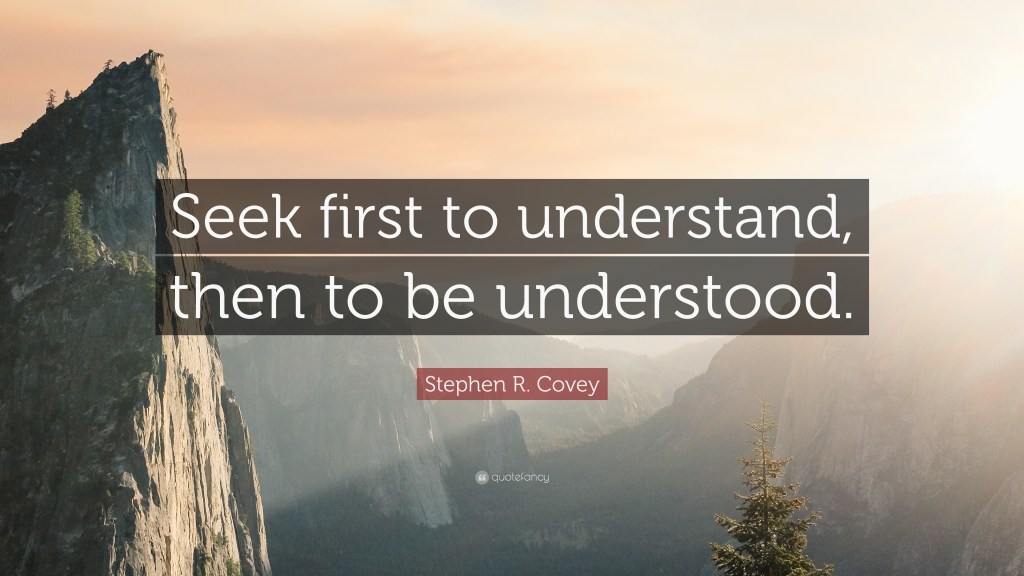
So, during this time, it is O.K. to put your stake in the ground so that others know where you stand. Just also realize that others have a different stake in a different ground and the best thing we can do as Stephen Covey has said is to “Seek first to understand.”
Have a wonderful Tuesday
-Dr Lindeman
 Dissemination of Inspiration